


Program
The festival program will feature a variety of activities, including intensive sessions, workshops, jam sessions, live performances, underscore events, morning practice, as well as opportunities for relaxation, leisurely walks, bodywork, discussions, and engaging conversations, among others.


Tactile Intelligence
Marcel & Maria Nurieva
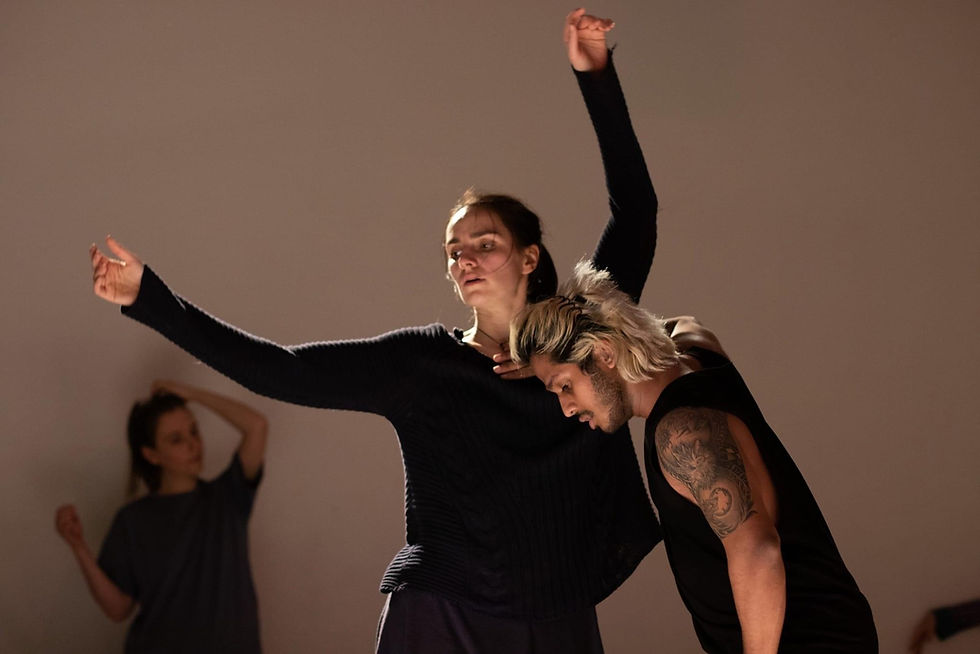
Tactile intelligence We pay attention to sensitive tune to each other, where we can find out non-verbal signs, sending and reading different qualities of touches. We will discover interactions through improvisation tools, and include some specific patterns as partnering frame work.

Le Point Zéro
Angelo Dello Lacono
The practice is structured around The Four Pillars of Expanded Awareness Self - body, breath, posture, inner awareness Self & Space - gravity, elements, spatial perception, flow Self & Others - partnering, contact, listening, interaction Mindset & Overall Vision - presence, intention, awareness, creative and collective intelligence Today, this research is guided by three interconnected perspectives: the deconstruction of movement through deep physical sensing; dialogue with modern science and physics, particularly gravity, dynamics and the behavior of matter; and a renewed connection with ancestral cultures in which dance was experienced as a vital human function, rather than solely as an institutional art form. The aim of Le Point Zéro is not to impose another vocabulary, but to give dancers tools to question, feel, understand and create movement, transforming partnering into a living dialogue between bodies, space, physics and human experience.
QUANTUM CONTACT:
Shifu Ash
In this class, you'll explore the art of partner dancing through the lens of microscopic awareness, focusing on the subtle language of touch. This class will guide you in mastering the delicate balance of taking responsibility for another's body while learning to command, listen, and negotiate through movement. You'll delve into key aspects such as building trust and understanding reflexivity—where every action invites a reaction. We'll also cover self-protection and safeguarding your partner, all while engaging your imagination to intuitively track and respond to your partner's movements. "Quantum Contact" is designed to deepen your understanding of touch and connection, transforming your dance practice into a refined and resonant dialogue.

Inside Out, Upside Down and Backwards: Moving Through the
Unknown
Nuria Bowart
When we are dancing Contact Improvisation, we encounter so many moments of the unexpected. Each moment unfolds from the next—there is no predicting chaos. However, we can learn to prepare ourselves for omnidirectional movement availability: moving into the back space, going upside down from all directions, navigating a fall to support what comes next. This class will focus on the skills of turning upside down and holding weight with any support. We will cover shoulder and spinal mechanics, elastic recoil, and being a bio-spiral. Practicing with our eyes closed and open, we will work through the lens of perception. Throughout this class, we will investigate what drives us to movement. Riding the waves of impulse and care, we will tune our skills of awareness and availability in our contact improvisation practice.
%20(59)_Original.jpg)
PASSING THROUGH
Aric Master
Passing through uses the dynamics of complex systems to create a collective web. The group will create dynamics that will be flexible, complex, getting the group to fit tight together, yet always keeping doors open for the unpredictable. The group moves constantly, transforming the environment of the dance. The room is full of pathways - infinite pathways passing through the walls, the floor, even the bodies. These pathways go in any direction and are filled with curves, large and small. Visible and invisible spirals are constantly passing through the students. Thus the “passing through” is created into a spontaneous composition. When the group becomes one mind, it can never get lost, there is never one person leading, everyone is following. The whole group is constantly traveling, weaving their bodies inside and out of their classmates and still always aware of the environment around them. After taking part in the “passing through” the student will learn to instantly connect with their environment and become more spontaneous in the making of choices as an improviser, choreographer or dancing in someone else’s work.

COMING SOON
Gopal Agarwal
Coming soon..